AudienceStrategic operators, ecosystem builders, and institutional partners
Product whitepaper
YunikTaxi is a Pi-first mobility platform built around trust, local safety, and future vehicle intelligence.
The visual positioning: trusted communities, an intelligent platform, a Pi-native economy, and better mobility for everyone.
YunikTaxi begins as a practical taxi service for the Pi Network ecosystem: customers request rides, drivers serve trips, and the platform organizes wallet activity, verification, local communities, and administrative controls around a shared Pi-native economy. The long-term ambition is larger: turn verified mobility activity into a safety intelligence layer that can help cities, fleets, drivers, riders, and future connected vehicles move with better local context.
YunikTaxi begins with one concrete service: a taxi ride. The larger transportation layer comes from there.
Pi needs real utility
The Pi Network ecosystem becomes stronger when people can use Pi for daily services. Transport is frequent, necessary, local, and naturally creates repeat transactions.
Mobility still has trust gaps
Riders and drivers need better visibility, verification, dispute handling, and community-level safety information, especially in regions where informal transport is common.
Local data is underused
Traffic, weather, crime patterns, unsafe streets, seasonal risks, and community reports can become a safety advantage when structured responsibly.
Pi ecosystem pattern
Useful Pi apps are strongest when they combine familiar user behavior with Pi-native identity, payments, participation, and discovery. YunikTaxi applies that ecosystem logic to a daily-world service: movement.
Mobility has higher utility density
A ride can involve identity, location, safety, payments, ratings, local merchants, country communities, support, and repeat behavior. That makes transport a strong candidate for meaningful Pi utility.
Thesis
The opportunity
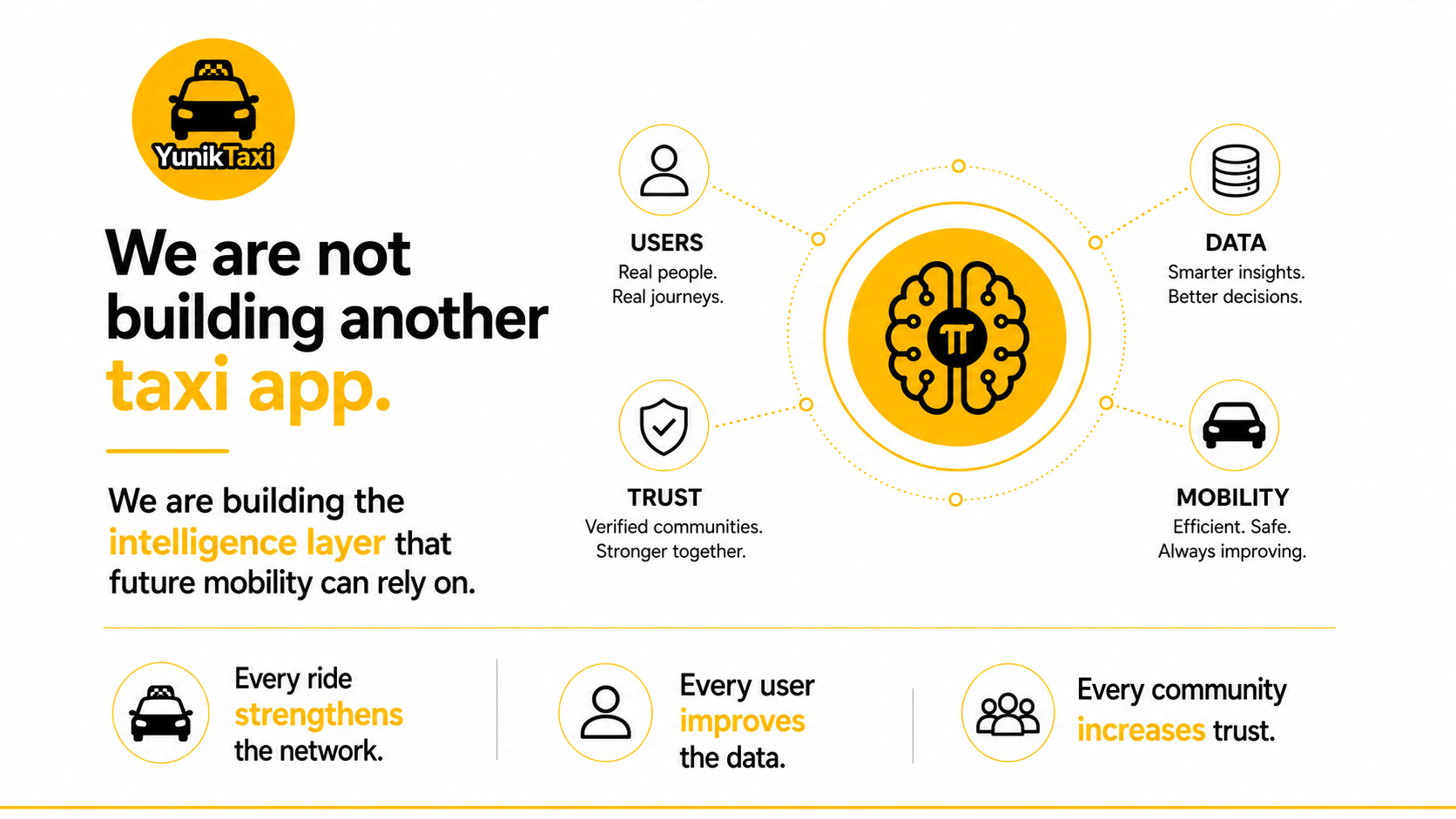
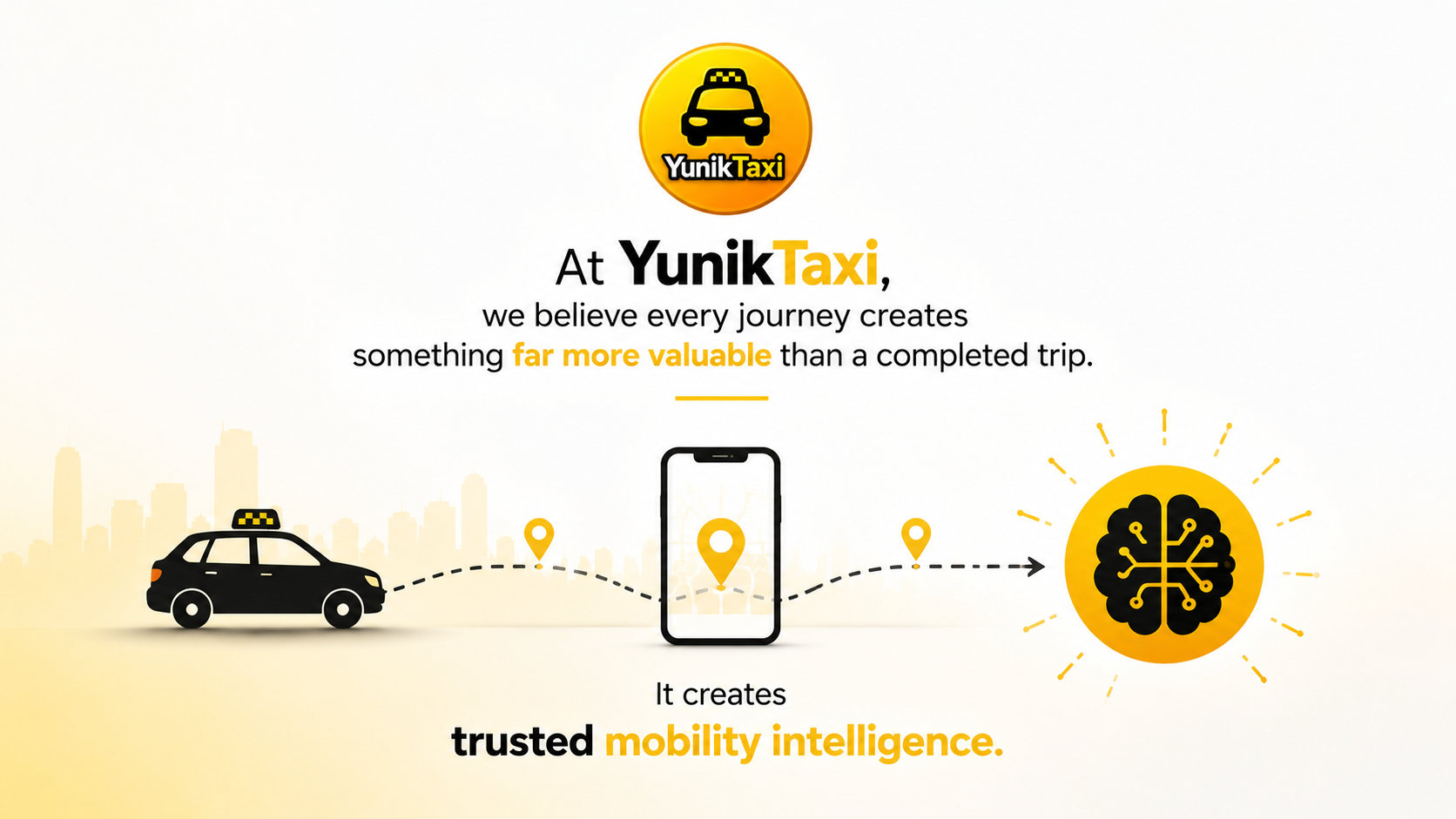
The long-term platform combines users, trust, data, and mobility into an intelligence layer future transport can rely on.
YunikTaxi can grow from a taxi app into a mobility intelligence layer.
The first product is deliberately concrete: book rides, manage drivers, hold balances, support country-specific communities, and build moderation workflows. That creates the operating data required for the larger ambition: safer routing, predictive risk, trusted mobility reputation, and eventually vehicle-connected services.
The core thesis is that a Pi-first transport network can become both a utility app and a data platform for safer movement. Every ride strengthens the network, every user improves the data, and every community increases trust. The durable advantage is not only software screens; it is the combination of local trust, verified driver supply, country-level communities, operational data, AI models trained around transport safety, and future hardware links to vehicles.
Strategic wedge
Start with human-operated taxis and country communities. Learn safety patterns. Build machine intelligence. Package the service layer for connected and autonomous vehicles later.
Research initiative
Safety Data Lab
A research function inside YunikTaxi
The Safety Data Lab would be a dedicated internal unit that turns verified local mobility information into structured, privacy-conscious safety intelligence. It would define the data schema for incidents, road hazards, unsafe pickup zones, weather-linked risk, seasonal patterns, cancellation anomalies, and route quality.
This matters because AI work only becomes credible when the platform has disciplined data collection, labeling, validation, and governance. The lab would produce the foundation for future route intelligence, risk models, moderation assistance, and city safety reporting.
Deliverables
Safety taxonomy, incident labels, anonymized research datasets, verifier rules, pilot reports, model evaluation dashboards, and country-level mobility safety summaries.
Data design
Define what the platform should collect, what it should avoid collecting, and how each safety signal should be verified.
Model readiness
Prepare clean training data for future ML models instead of relying on noisy, unstructured reports.
Public value
Convert local knowledge into safer ride decisions without exposing sensitive user identities.
Launch initiative
City Pilot Program
The City Pilot Program would launch YunikTaxi in selected cities or countries with a controlled rollout plan. Instead of trying to scale everywhere at once, the platform would prove one repeatable operating model: recruit verified drivers, onboard Pi users, test ride flows, validate wallet behavior, moderate country channels, collect safety data, and measure retention.
Select pilot markets based on Pi community activity, taxi demand, smartphone access, driver readiness, and local partner availability.
Build launch teams for driver onboarding, community support, safety verification, field testing, and local marketing.
Publish transparent pilot reports that show completed rides, active drivers, issue resolution, user feedback, safety alerts, and roadmap progress.
Create a repeatable playbook for each new country so growth becomes operationally disciplined.
Product today
What the system already organizes
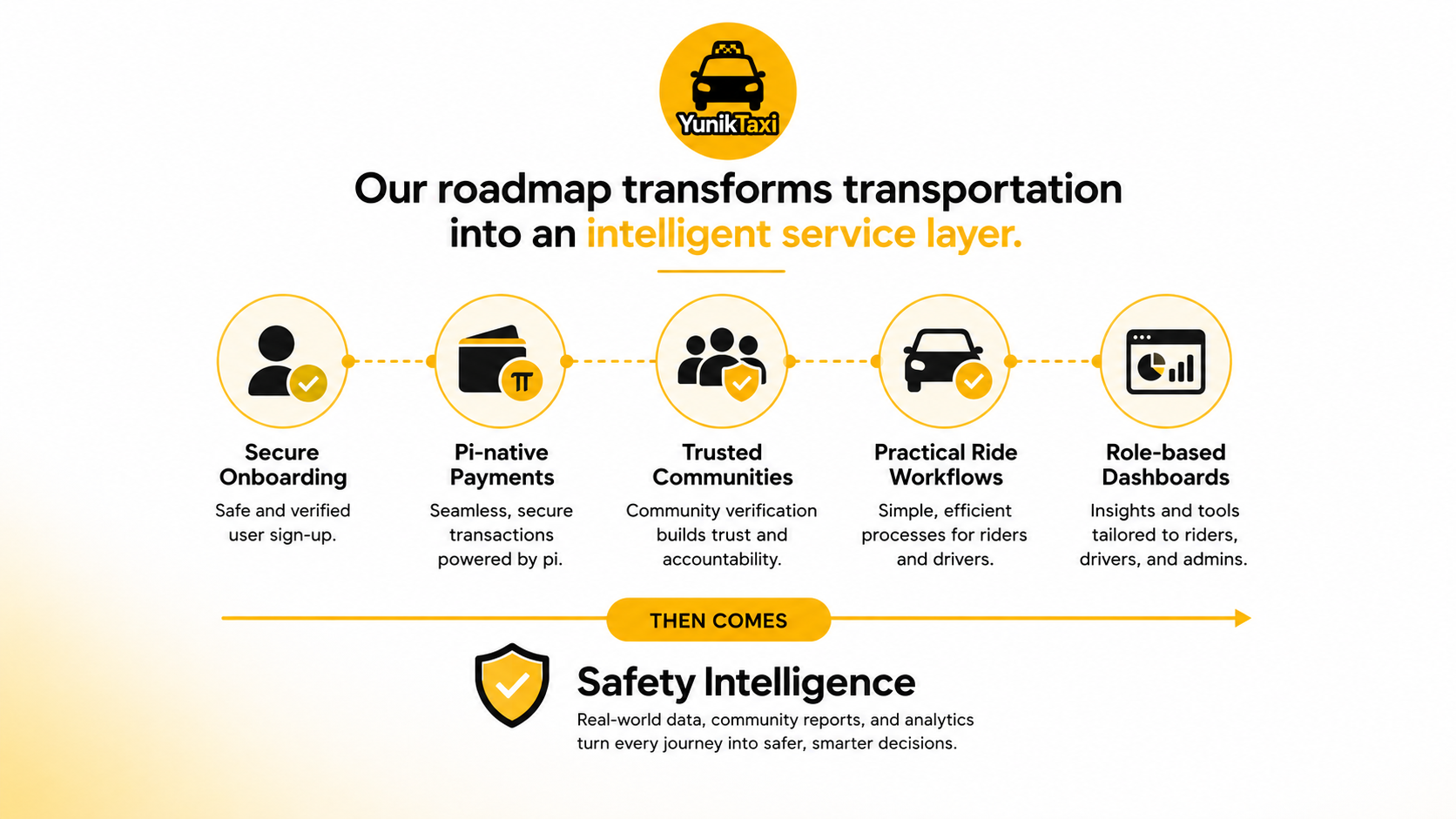
The service layer starts with secure onboarding, payments, communities, ride workflows, and role-based dashboards, then advances into safety intelligence.
Role-based app
Customers, drivers, verifiers, and admins each have focused views. This keeps the operating surface clear while still allowing shared services such as messaging, wallet activity, country selection, and safety workflows.
Ride workflow
The product supports booking, driver assignment flows, trip state, ride history, reviews, and protected payment logic so the marketplace can build confidence before scaling.
Admin control
Admins can manage users, settings, themes, pricing, withdrawals, media, plugins, legal text, countries, and community moderation from a centralized operating console.
Community layer
Country channels, subscriptions, posts, likes, comments, reports, and verification votes turn local knowledge into a structured community safety system.
Customer experience
Riders get a Pi-native transport workflow
Customers should be able to request rides, understand fares, communicate with drivers, complete reviews, and participate in their country's transport community. The intended experience is simple: open the app, choose where to go, ride with more context, and keep the transaction inside the Pi ecosystem.
Country-linked profiles help localize pricing, communities, legal expectations, and safety signals.
Wallet and escrow thinking protects the customer and driver during the ride lifecycle.
Messaging and notifications support real-time coordination.
Community alerts can make riders aware of unsafe areas, closures, weather risk, or local incidents.
Driver experience
Drivers become verified Pi mobility providers
Drivers need tools that are direct and operational: receive ride requests, manage vehicle details, track earnings, chat with customers, and build reputation. YunikTaxi's driver side should become a trusted workbench for people who want to earn inside the Pi economy.
Driver verification and profile history reduce marketplace uncertainty.
Vehicle and location tools prepare the system for live dispatch and future connected-car workflows.
Earnings, withdrawals, and reviews give drivers a clearer commercial record.
Driver participation in post verification helps communities validate local information faster.
Country network
Countries are local channels, not just profile fields
Local relevance
Mobility is deeply local. Country channels allow YunikTaxi to separate what is globally useful from what is locally urgent: regulations, safety warnings, cultural norms, road conditions, driver availability, and community updates.
Subscription model
Users can follow countries that matter to them while the interface keeps subscribed channels prominent. This supports travelers, cross-border drivers, regional operators, and communities that need clean local signal.
Trust layer
Verification turns community posts into reliable operational signal
Distributed review
Country-specific users can help approve or disapprove posts so safety and community information is not dependent on a single moderator.
Thresholds
Posts can require enough approvals or disapprovals before becoming accepted or rejected. This helps avoid overreacting to weak signal.
Flag handling
Flagged content can be isolated for admin review, creating a moderation trail that protects both community quality and platform credibility.
Pi ecosystem
Pi is the center of the commercial story
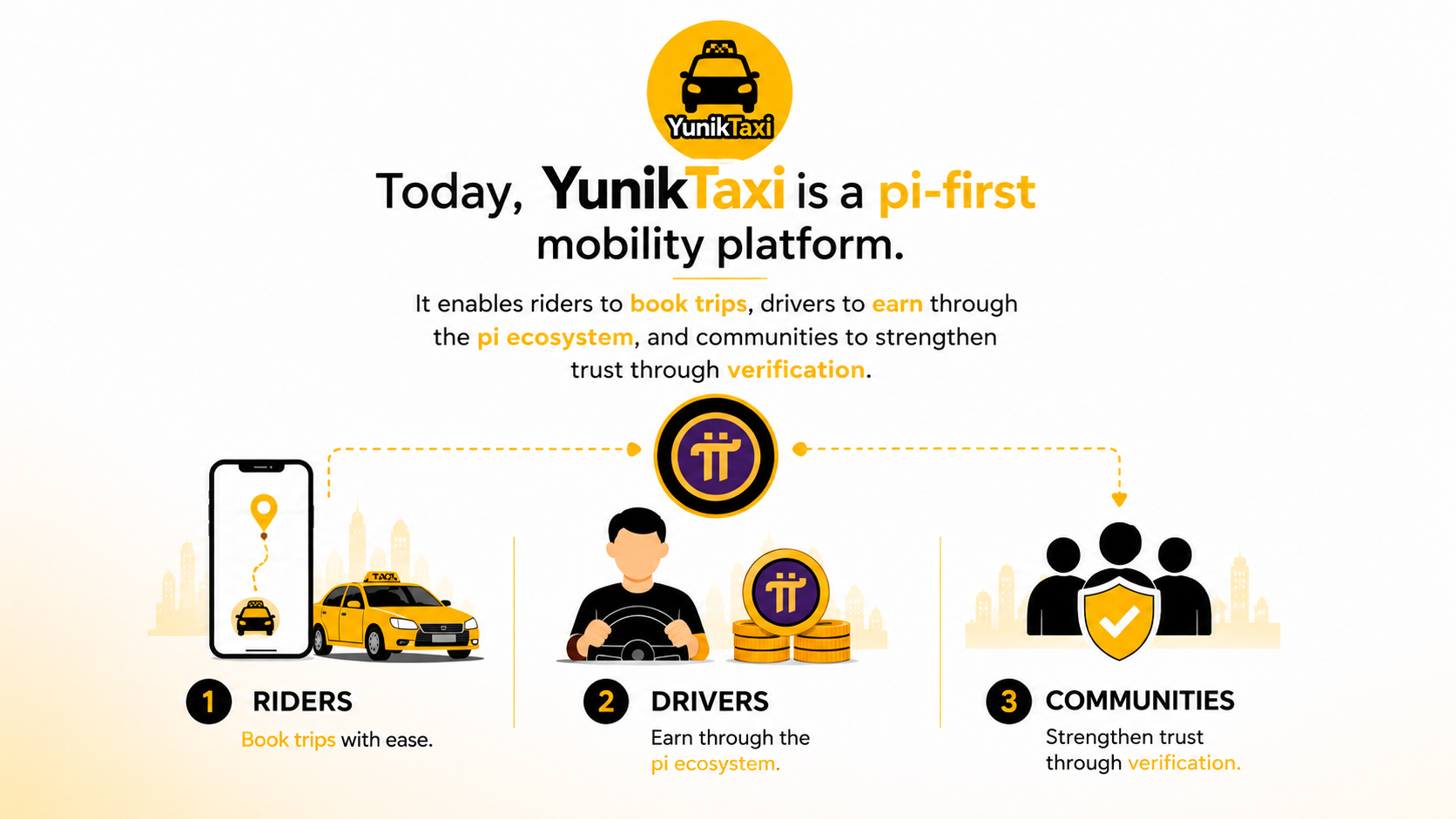
The Pi-first loop connects riders booking trips, drivers earning through the Pi ecosystem, and communities strengthening trust through verification.
YunikTaxi is positioned for the Pi Network ecosystem: identity, wallet flows, ride commerce, driver earnings, country expansion, and community trust should all reinforce practical Pi utility. The platform applies a simple ecosystem pattern: pair a familiar real-world behavior with Pi-native identity, payments, participation, and discovery.
Transport creates repeat demand rather than one-time novelty transactions.
Drivers gain a clear reason to accept and earn Pi through useful work.
Customers gain a daily-world reason to keep Pi active and valuable.
The platform can become a reference case for Pi-enabled local services.
Commerce mechanics
Wallet and escrow logic create trust in each ride
Marketplace confidence
In a ride marketplace, the customer wants proof that payment will not disappear unfairly, and the driver wants proof that work will be paid. A wallet-led, escrow-minded flow gives both sides a more transparent path from booking to completion.
Trust principle
Escrow behavior is more than a payment feature. It is a trust feature, and trust is the core asset of a transport marketplace.
Network effects
Every ride can strengthen the local Pi economy
More customers
More riders create more earning opportunities and stronger reasons for drivers to join.
More drivers
More drivers improve availability, reliability, pickup time, and local coverage.
More local data
More trips and community reports create stronger safety intelligence, better routing, and better market operations.
Developer ecosystem
YunikTaxi welcomes plugin development that strengthens Pi utility
A controlled extension path for useful ecosystem builders
YunikTaxi is designed to support a plugin model where trusted third-party developers can build capabilities around mobility, safety, country operations, Pi commerce, driver tools, customer experience, analytics, hardware integrations, and local ecosystem partnerships.
The platform welcomes developers whose work is beneficial to the Pi Network ecosystem and aligned with YunikTaxi's trust, safety, privacy, and real-world utility standards. The goal is to let useful builders extend the product without weakening the core mobility experience.
Developer principle
Plugins should create practical value for Pioneers, drivers, communities, cities, fleets, or ecosystem partners. Extensions that improve safety, access, Pi utility, and operational quality are the priority.
Mobility plugins
Route helpers, local dispatch tools, driver productivity, country-specific services, accessibility features, and fleet operations modules.
Safety plugins
Incident reporting, safer pickup guidance, verification workflows, emergency integrations, weather risk, and community alert improvements.
Pi ecosystem plugins
Pi-native commerce, partner merchant tools, loyalty systems, local utility services, and developer integrations that increase meaningful Pi usage.
Safety intelligence
The future product is safer movement, not only ride booking
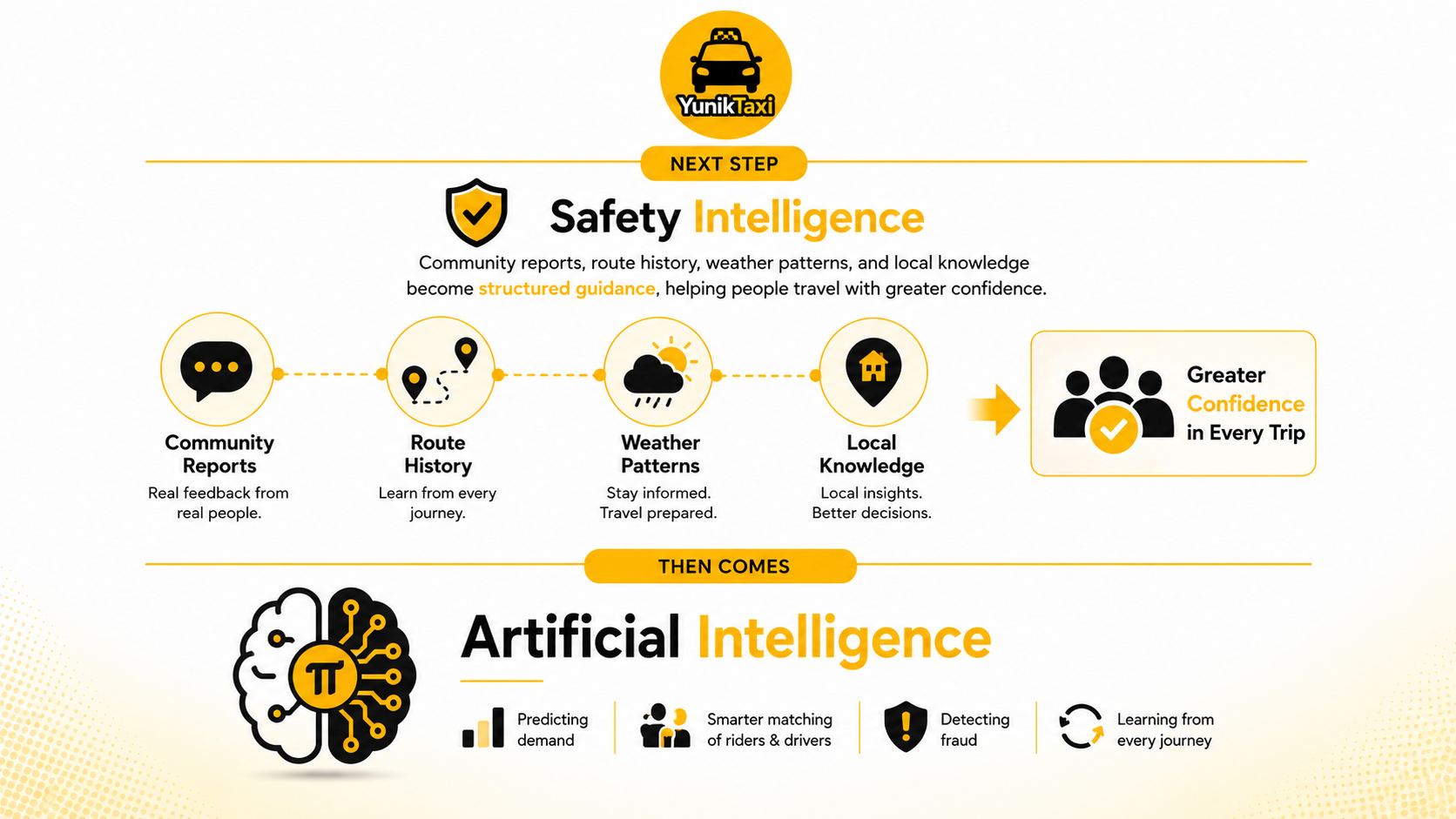
Safety intelligence turns community reports, route history, weather patterns, and local knowledge into structured guidance.
From reports to intelligence
YunikTaxi can use verified local reports, map data, ride patterns, weather, seasonal events, and external public signals to identify areas that may need caution. The goal is not to create fear; the goal is to help riders, drivers, and fleets make better choices.
Examples include streets to avoid at night, pickup zones with repeated incidents, seasonal flood-prone roads, high-risk waiting areas, unsafe drop-off points, and changing weather conditions that affect driving behavior.
Safety promise
YunikTaxi should treat safety information as decision support. The system should explain uncertainty, encourage verification, and protect users from careless profiling.
Learning inputs
Signals the platform can responsibly learn from
Each completed journey can create trusted mobility intelligence, not only a ride receipt.
Map and route data
Road type, route complexity, traffic density, pickup patterns, drop-off patterns, and route deviations can help models understand trip difficulty.
Community reports
Verified user posts can identify hazards, unsafe places, service interruptions, transport strikes, road closures, or local alerts.
Weather and seasons
Rain, heat, fog, floods, holidays, night travel, and seasonal demand shifts can shape pricing, ETAs, driver guidance, and safety warnings.
Trust and behavior
Completion rates, cancellation patterns, review signals, verification outcomes, and fraud indicators can improve marketplace health.
Responsible data
Safety intelligence must be governed carefully
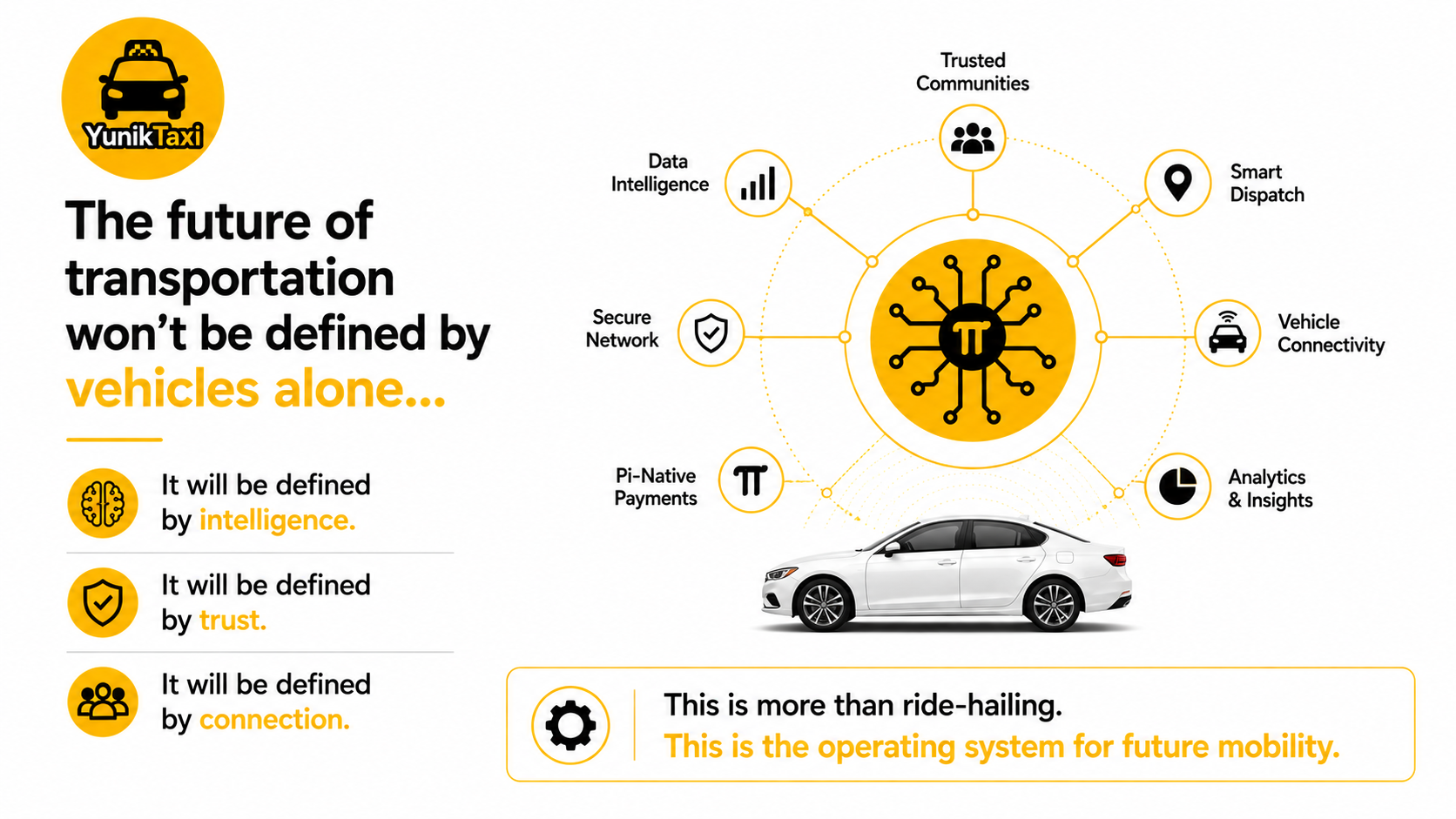
The future mobility operating system depends on data intelligence, secure networks, Pi-native payments, smart dispatch, vehicle connectivity, and analytics.
The long-term AI vision depends on trust. YunikTaxi should collect only what is needed, protect user identities, preserve consent choices, and separate personal data from aggregate safety intelligence wherever possible.
Use profile country and trip context to localize service without exposing unnecessary personal information.
Prefer aggregate risk signals for public safety guidance.
Keep sensitive review and moderation actions auditable for admins.
Design AI output as assistance for humans, not as hidden authority.
Roadmap
From Pi taxi marketplace to autonomous-ready service layer
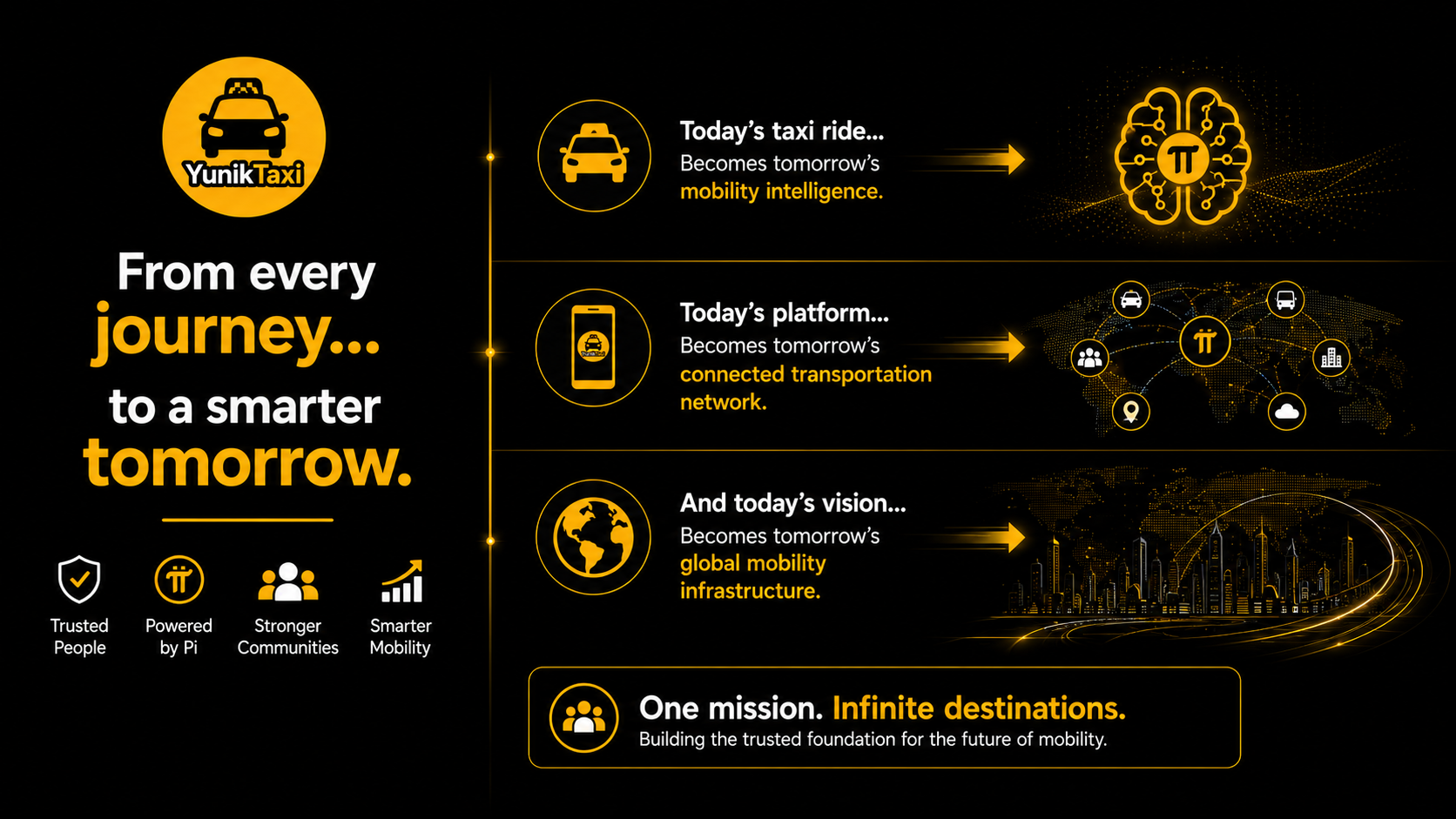
Today's taxi ride becomes tomorrow's mobility intelligence, connected transportation network, and global mobility infrastructure.
The app foundation is focused on Pi Network login, wallet-led ride commerce, role-based dashboards, country communities, moderation, and practical trip workflows.
Pi-centered onboarding
Customer and driver dashboards
Escrow-minded ride flows
Country channels and post verification
YunikTaxi can begin converting community reports, country context, route history, weather, and seasonal signals into structured safety guidance.
Street and place risk tags
Local safety alerts
Verifier-backed reports
Weather and seasonal caution
The next operating layer is model-assisted decision support for safer routes, fraud reduction, demand prediction, and rider-driver matching.
Risk scoring models
Demand heatmaps
Trust signals
Anomaly and abuse detection
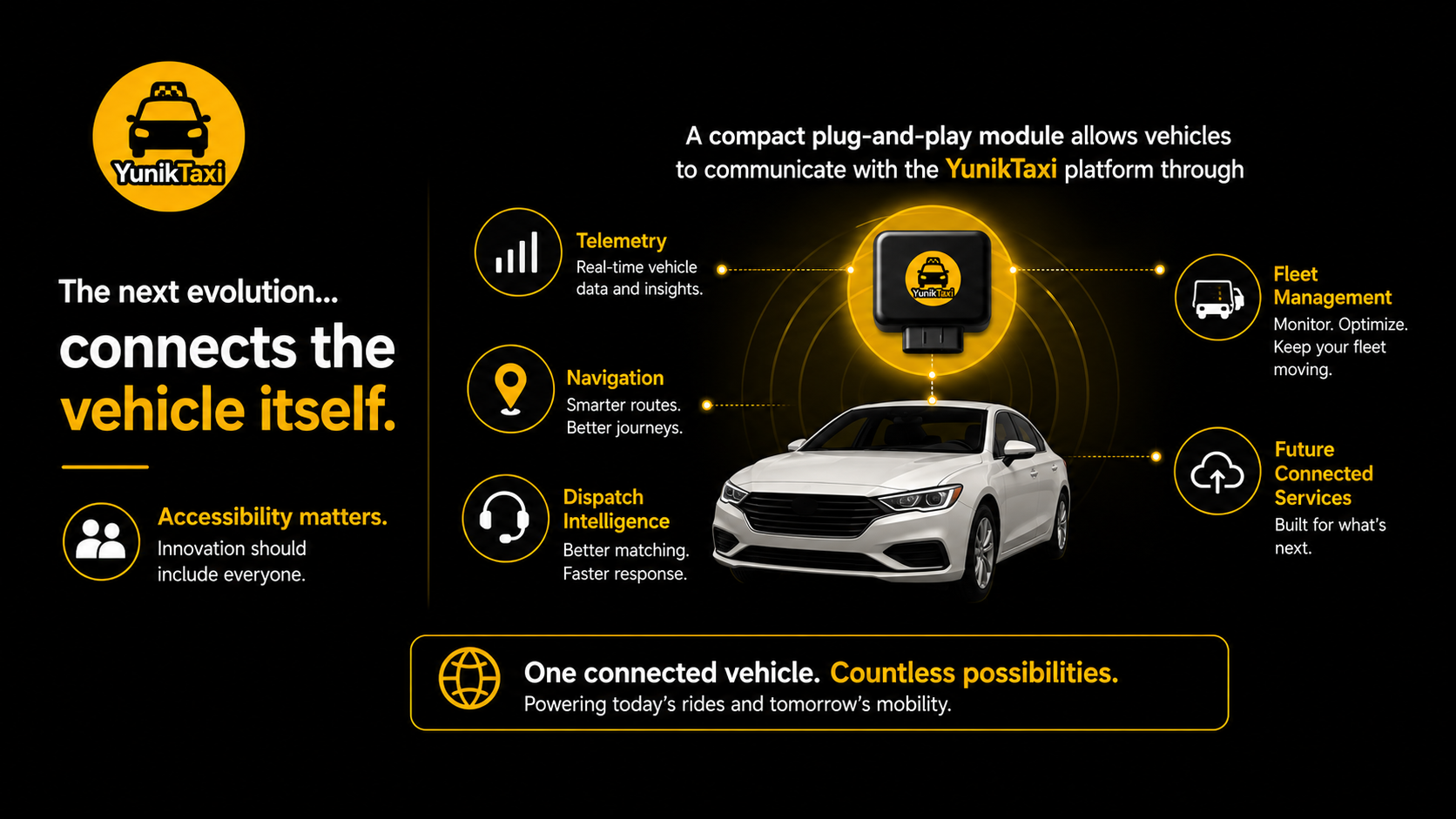
A compact vehicle module can connect taxis to YunikTaxi servers, enabling telemetry, dispatch, payment state, navigation, and safety intelligence in one service layer.
Plug-in vehicle module
Cloud connection
Infotainment stack
Fleet telemetry
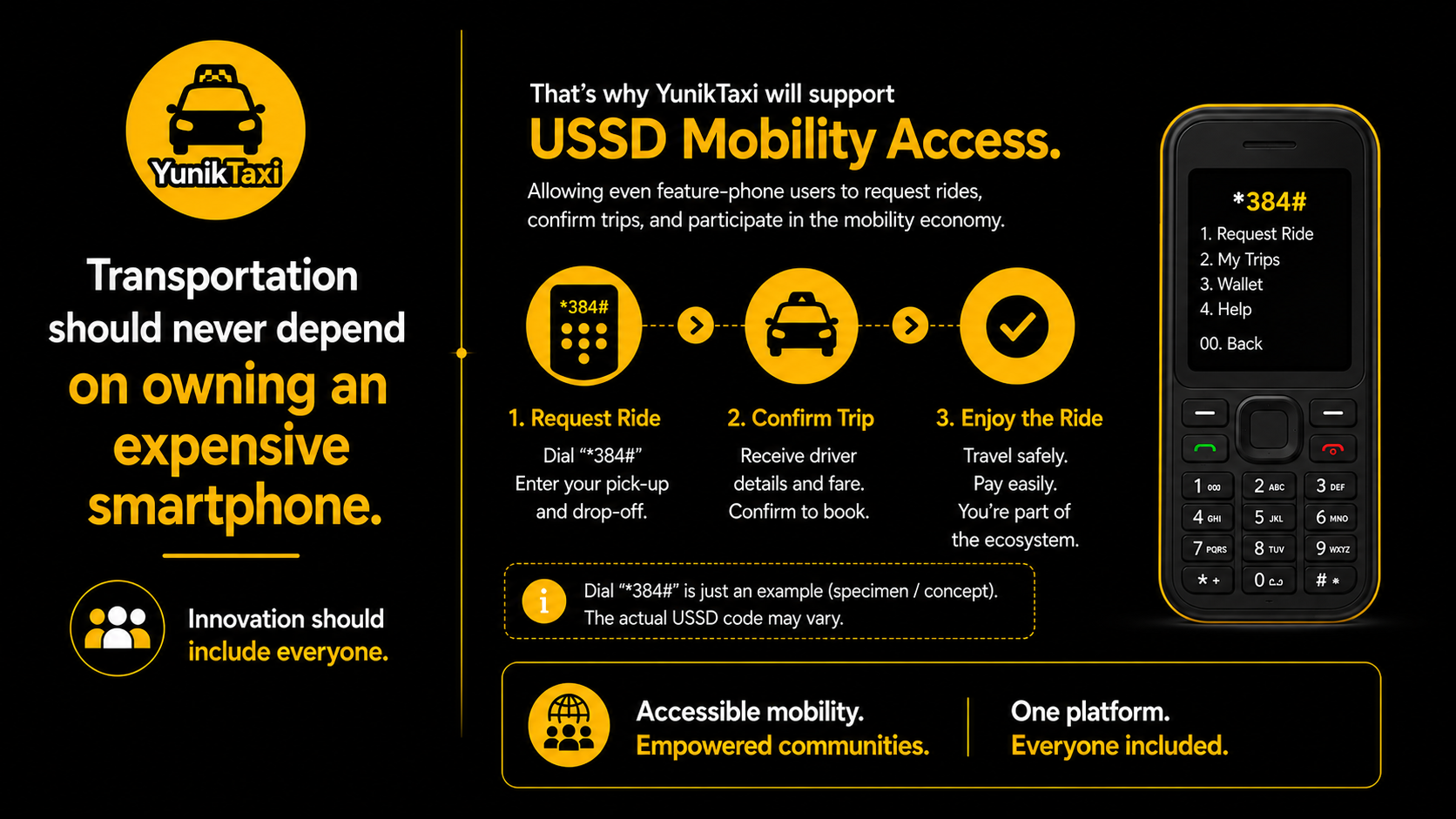
YunikTaxi plans to support low-bandwidth mobility flows for people without smartphones, using USSD-style sessions and Pi-backed mobility tokens for essential taxi access.
Feature-phone ride requests
Token-based Pi utility
Offline-friendly confirmations
Low-tech country pilots
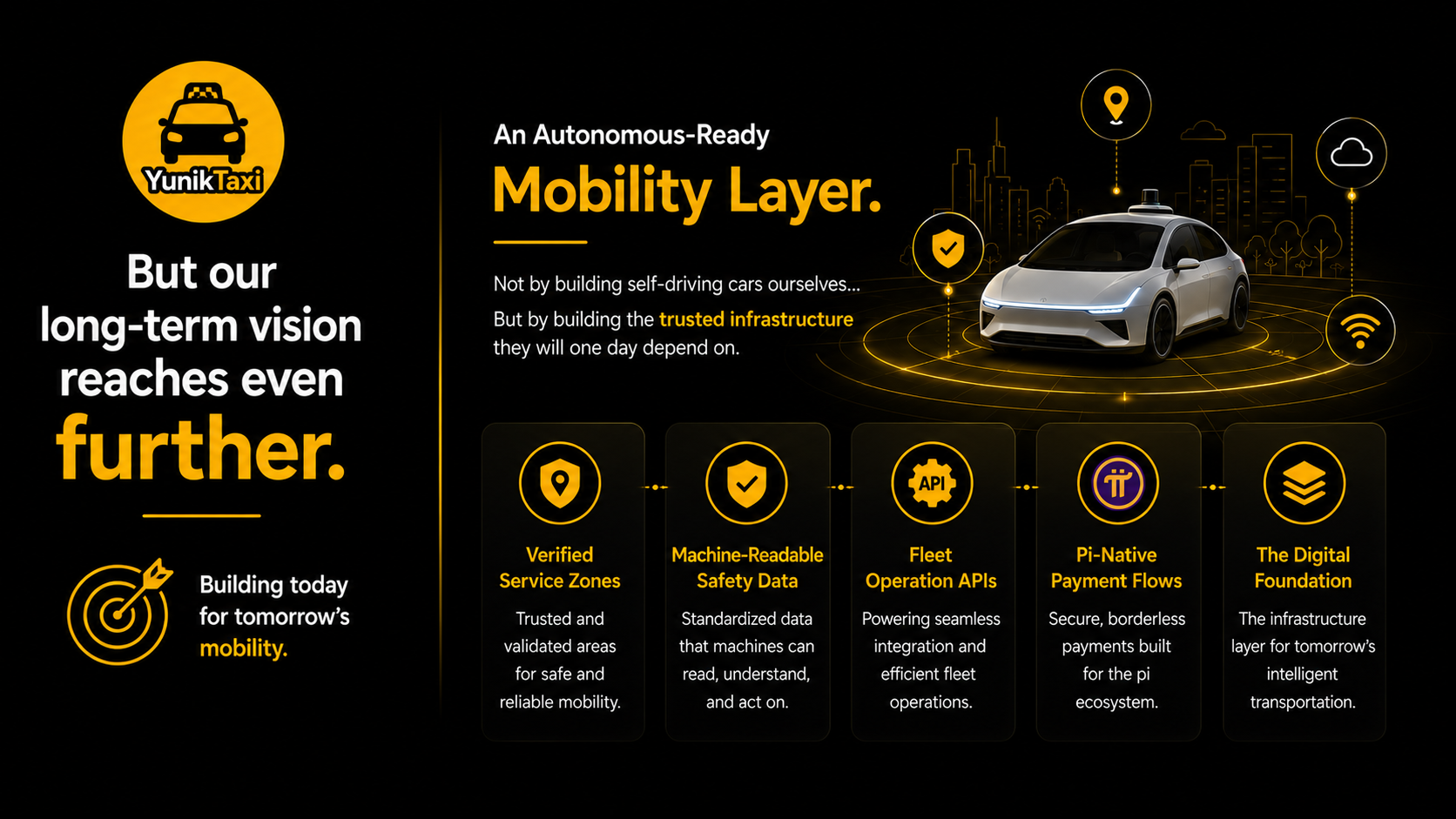
The long-term ambition is a simple plug-and-play data and service layer that autonomous vehicles can use for taxi operations, local safety context, and Pi-native payment flows.
Autonomous service API
Verified service zones
Machine-readable safety data
Fleet operations console
YunikTaxi can later consider adjacent service lines once the core ride marketplace, trust layer, and operations playbook are stable.
Chauffeur services
Tours and destination experiences
Security transportation
Corporate and event mobility
Current
Pi mobility foundation
The app foundation is focused on Pi Network login, wallet-led ride commerce, role-based dashboards, country communities, moderation, and practical trip workflows.
Pi-centered onboarding
Customer and driver dashboards
Escrow-minded ride flows
Country channels and post verification
Next
Safety intelligence pilot
YunikTaxi can begin converting community reports, country context, route history, weather, and seasonal signals into structured safety guidance.
Street and place risk tags
Local safety alerts
Verifier-backed reports
Weather and seasonal caution
Build
Machine learning operations
The next operating layer is model-assisted decision support for safer routes, fraud reduction, demand prediction, and rider-driver matching.
Risk scoring models
Demand heatmaps
Trust signals
Anomaly and abuse detection
Prototype
IoT and vehicle interface
A compact vehicle module can connect taxis to YunikTaxi servers, enabling telemetry, dispatch, payment state, navigation, and safety intelligence in one service layer.
Plug-in vehicle module
Cloud connection
Infotainment stack
Fleet telemetry
Inclusion
USSD mobility access
YunikTaxi plans to support low-bandwidth mobility flows for people without smartphones, using USSD-style sessions and Pi-backed mobility tokens for essential taxi access.
Feature-phone ride requests
Token-based Pi utility
Offline-friendly confirmations
Low-tech country pilots
Long range
Autonomous-ready mobility layer
The long-term ambition is a simple plug-and-play data and service layer that autonomous vehicles can use for taxi operations, local safety context, and Pi-native payment flows.
Autonomous service API
Verified service zones
Machine-readable safety data
Fleet operations console
Future options
Premium and specialized transport services
YunikTaxi can later consider adjacent service lines once the core ride marketplace, trust layer, and operations playbook are stable.
Chauffeur services
Tours and destination experiences
Security transportation
Corporate and event mobility
Future service categories to consider
Once the core taxi marketplace is stable, YunikTaxi can evaluate specialized mobility lines that fit the trust, safety, and Pi-native commerce model.
Chauffeur services for premium, scheduled, or executive transport.
Tours and destination experiences for visitors, local guides, and partner merchants.
Security transportation for higher-safety journeys, vetted drivers, and sensitive routes.
Corporate, event, and group mobility for organizations that need coordinated transport.
AI direction
Machine learning can become the safety and operations brain
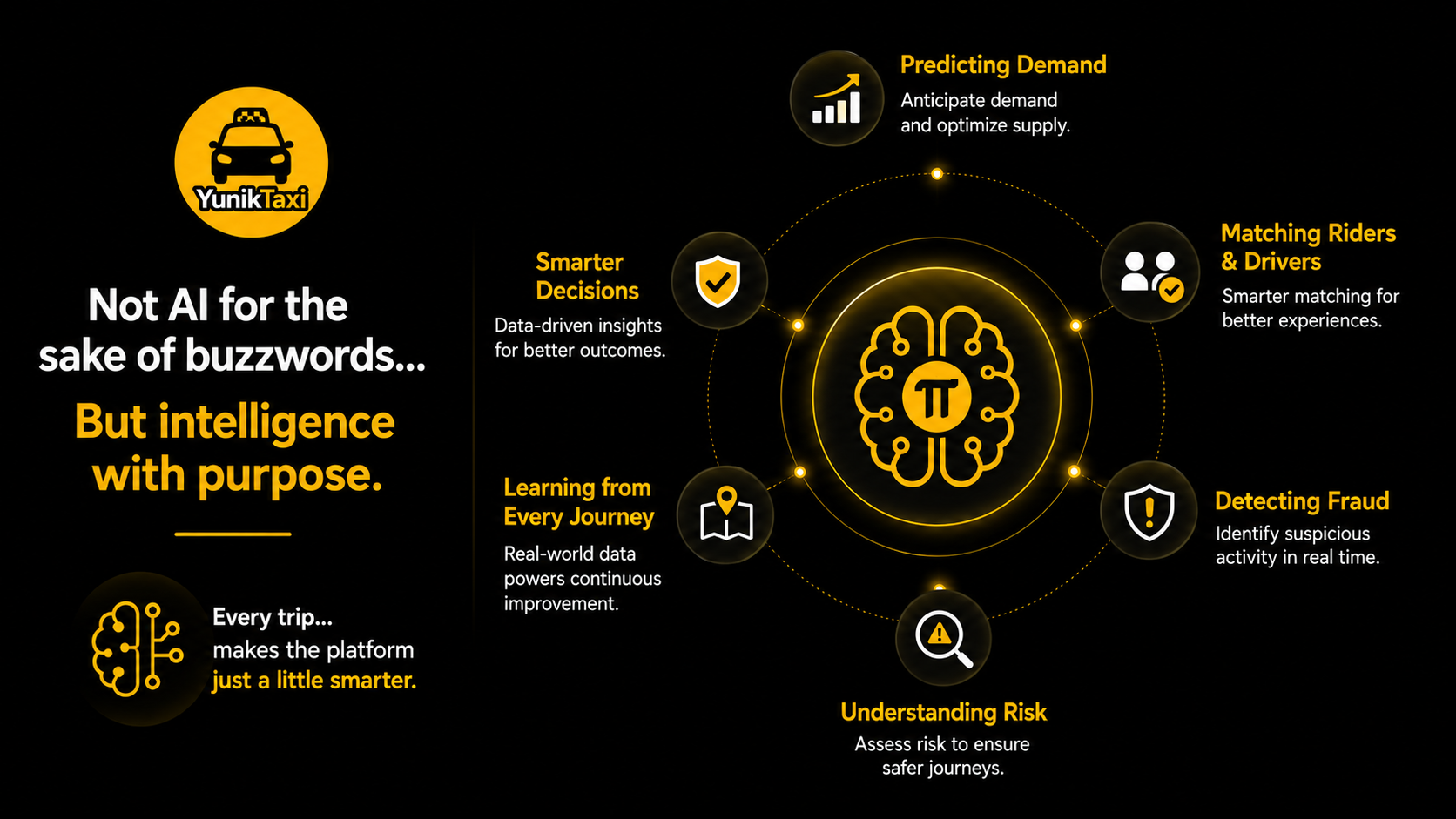
AI is framed as intelligence with purpose: demand prediction, matching, fraud detection, risk understanding, and continuous learning.
Route risk scoring
Estimate safer routes using verified incidents, time of day, road conditions, weather, and historic movement patterns.
Demand prediction
Help drivers know where demand is likely to appear, improving coverage and reducing unnecessary waiting time.
Fraud and abuse detection
Detect suspicious behavior across accounts, rides, wallet actions, reviews, reports, and verification votes.
Safety guidance
Provide riders, drivers, and admins with understandable guidance instead of opaque scores.
Low-tech access
USSD can bring Pi-powered mobility to people without smartphones
USSD access supports feature-phone ride requests, trip confirmations, wallet actions, and help flows. The shown code is a specimen concept.
Mobility should not depend on owning a modern phone
YunikTaxi plans to explore USSD technologies so riders and drivers in low-connectivity regions can access essential mobility services without installing an app or relying on mobile data. A simple dial-in session could support basic ride requests, pickup confirmation, driver matching, fare visibility, trip status, and account actions on feature phones.
This future layer expands the platform beyond smartphone-first users. It positions YunikTaxi to serve rural areas, informal settlements, low-income communities, older users, and regions where internet coverage, device affordability, or digital literacy remain barriers to mobility access.
Access principle
YunikTaxi's long-term mission is to make trusted mobility available in the lowest-tech places in the world, while keeping Pi Network utility at the center of the transaction layer.
USSD ride flows
Users could dial a short code, choose pickup and destination options, confirm a ride, receive driver details, and complete basic trip steps through numbered menus.
Pi-backed mobility token
YunikTaxi plans a token-based system built under the Pi Network ecosystem to represent mobility access, ride value, loyalty, settlement, or local transport credits in low-tech channels.
Bridge to the main app
USSD activity can sync with the core YunikTaxi platform so admins, drivers, safety workflows, country channels, and future AI systems still operate from one trusted backend.
Autonomous readiness
A plug-and-play vehicle layer is the long-term frontier
Autonomous readiness means trusted infrastructure: verified service zones, machine-readable safety data, fleet APIs, Pi-native payment flows, and a digital foundation.
Hardware direction
YunikTaxi can explore a compact hardware module, similar in simplicity to a flash drive from the user perspective, that connects a vehicle to YunikTaxi servers. The module would not be treated casually as a full self-driving system on day one. It would begin with connectivity, telemetry, dispatch state, payment state, route intelligence, and safety data.
Over time, that connected layer can support deeper vehicle services: infotainment, fleet tools, driver-assistance integrations, emergency signaling, maintenance alerts, verified service zones, machine-readable safety data, fleet operation APIs, and eventually autonomous-ready taxi service APIs where regulation, vehicle capability, and safety testing allow.
Practical path
Start with connected taxi operations. Prove reliability, safety intelligence, and fleet economics. Then move toward autonomous compatibility through measured hardware and software prototypes.
Hardware roadmap
From driver kit to connected vehicle module
The plug-and-play module concept connects vehicles to telemetry, navigation, dispatch intelligence, fleet management, and future connected services.
01
Driver safety kit
Phone mount, charging support, visible vehicle identity, optional emergency button, and guidance for camera or dash recording integrations where lawful.
02
Connected module
A compact server-connected module for GPS, trip state, device identity, panic signal, telemetry, and future fleet diagnostics.
03
Infotainment prototype
In-vehicle display concepts for ride status, Pi payment state, safety alerts, driver guidance, passenger notices, and partner merchant offers.
04
Autonomous API bridge
A future abstraction layer for dispatch, ride authorization, safe-zone logic, verified map context, payment events, and remote fleet operations.
Resource plan
How added capacity strengthens delivery
Software and intelligence
Advance the app platform, Pi SDK flows, wallet and escrow logic, admin systems, country communities, Safety Data Lab, data pipelines, machine learning models, route intelligence, fraud detection, moderation assistance, and explainable AI guidance.
Team and market execution
Strengthen the core YunikTaxi team across engineering, product, design, AI research, safety operations, support, driver onboarding, city pilots, Pi community growth, partnerships, and launch operations tied to measurable milestones.
Hardware and vehicle systems
Support IoT prototypes, connected vehicle modules, telemetry capture, device identity, panic input, vehicle dashboards, infotainment concepts, testing kits, and the long-term autonomous-ready vehicle service layer.
Team capacity
Team capacity keeps the delivery engine consistent
Core team compensation matters because software, safety research, driver onboarding, country operations, support, testing, and AI development require consistent human effort. Compensation is tied to delivery, transparency, and measurable outcomes.
Engineering capacity covers platform reliability, Pi SDK work, ride flows, wallet logic, security hardening, admin tools, and mobile performance.
Data and AI capacity covers the Safety Data Lab, model design, data cleaning, annotation, evaluation, and responsible AI governance.
Operations capacity covers city pilots, driver onboarding, local partnerships, support, moderation, verifier management, and safety response workflows.
Market growth capacity covers Pi community growth, country launches, educational content, ambassador programs, and measurable acquisition campaigns.
Execution
Milestones that make the vision measurable
01
Stabilize Pi ride commerce
Reliable onboarding, wallets, ride state, admin controls, country selection, and legal acceptance.
02
Grow country communities
Subscribed country feeds, searchable discovery, moderation, verified posts, and local safety categories.
03
Launch safety intelligence pilots
Collect structured reports, combine with route/weather signals, and test user-facing safety guidance.
04
Prototype connected vehicle services
Build IoT proof of concept for vehicle identity, telemetry, dispatch integration, infotainment, and server connectivity.
Metrics
The right metrics connect utility, trust, and safety
Marketplace utility
Completed rides, active riders, active drivers, repeat usage, trip completion rate, and wallet settlement reliability.
Community trust
Verified posts, moderation speed, flag resolution, approval ratios, country channel activity, and report usefulness.
Safety outcomes
Alert accuracy, avoided-route adoption, incident reductions, high-risk zone detection, and driver/rider confidence.
Closing note
YunikTaxi is building toward practical Pi utility first, then intelligence that makes movement safer.
The strongest version of YunikTaxi is not only an app that books taxis. It is a mobility system that helps people move, helps drivers earn, helps communities share verified local knowledge, and gives future vehicles a cleaner service layer for trusted transport.
YunikTaxi operates a ride booking, driver, wallet, messaging, verification, media, referral, advertising, and plugin-enabled transport platform. This policy explains the information we collect, how we use it, and the choices available to users.
Information we collect
We collect account details such as name, username, email address, phone number, account role, password credentials, country, profile photo, account status, verification status, wallet balance, referral codes, and login/session data. Drivers may provide license details, national ID details, date of birth, address, emergency contact information, experience, vehicle information, inspection and insurance expiry dates, vehicle media, and identity or license document uploads. Riders and drivers may create ride requests, rides, saved places, pickup and drop-off addresses, location coordinates, trip status events, reviews, tips, payments, wallet transactions, withdrawal requests, messages, notifications, and support or verifier activity. When enabled, the app can process manual location entries, live GPS location, map searches, media uploads, social/plugin features, demo rides, ads, and Pi SDK login, wallet deposits, withdrawals, rewarded ads, Pi usernames, Pi user IDs, hashed access tokens, price cache, and exchange-rate cache. Payment plugins may add their own provider references, but payment card or external wallet processing is handled by the relevant provider.
How we use information
We use information to create and secure accounts, provide rider and driver modes, match riders and drivers, estimate fares, manage trip status, display nearby drivers, process wallet balances, escrow, tips, deposits, withdrawals, refunds, platform earnings, and transaction histories, operate messages and notifications, verify drivers and customer verifier work, manage referrals, personalize country-specific pricing and social content, moderate abuse, run admin tools, diagnose errors, maintain security, and comply with applicable obligations.
Location and country
Country selection is stored on the user profile and may be used for pricing, availability, notifications, compliance, and regional features. GPS or map location is used only when a user enables or submits it for ride, pickup, driver availability, nearby driver, or related map features.
Sharing
We share only the information needed to operate the service, such as rider pickup/drop-off details with assigned drivers, driver vehicle/profile details with riders, messages between conversation participants, verifier assignments with authorized reviewers, admin-visible records for platform operations, and limited data with active plugins or external providers required for authentication, payments, maps, ads, exchange rates, or other enabled features.
Retention and security
We retain records as needed for account operation, ride history, wallet accounting, safety, disputes, audits, and legal compliance. Passwords and Pi access tokens are stored as hashes where applicable. No system can be guaranteed perfectly secure, but we use access controls, session protection, CSRF protection, and operational safeguards to reduce risk.
User choices
Users can update profile information including country from their account page or from the dashboard country prompt. Users can choose whether to provide optional media, saved places, manual locations, and some account details. Requests to access, correct, delete, or restrict information should be sent to the platform operator using the support channel provided by YunikTaxi.
Changes
We may update this policy as the platform, plugins, laws, or business operations change. Continued use after an update means the latest policy applies.
Terms and Conditions
Terms and Conditions
Last updated: July 30, 2026
These terms govern use of YunikTaxi, including rider, driver, admin, verifier, wallet, messaging, media, referral, advertising, and plugin-enabled features. By registering, signing in, using Pi SDK registration or authentication, booking rides, driving, verifying records, messaging, uploading media, or using wallet features, you agree to these terms and the Privacy Policy.
Accounts
You must provide accurate information, keep your login credentials secure, choose and maintain a valid country on your profile, and use only account modes you are authorized to use. The platform may suspend or restrict accounts that are inaccurate, unsafe, fraudulent, abusive, inactive, or otherwise violate these terms.
Riders
Riders are responsible for entering accurate pickup and drop-off information, being available for the ride, paying applicable fares, fees, tips, cancellation amounts, wallet charges, escrow releases, and any approved adjustments. Ride estimates may change due to distance, duration, waiting time, driver terms, country-specific pricing, route changes, or platform settings.
Drivers
Drivers must provide accurate profile, license, identity, vehicle, insurance, inspection, availability, and location information. Drivers are responsible for legal eligibility, safe conduct, vehicle condition, accepting or declining requests responsibly, completing trips honestly, and complying with country-specific pricing limits and platform-approved driver terms.
Wallet, payments, deposits, and withdrawals
Wallet balances, escrow holds, deposits, withdrawals, refunds, tips, driver payouts, system earnings, and provider references are recorded by the platform and may be corrected for errors, disputes, failed provider confirmations, fraud, chargebacks, or policy violations. External payment, map, ad, exchange-rate, Pi, and other plugin providers may apply their own terms.
Verification, messages, media, and conduct
Uploaded documents and media must be lawful and truthful. Verifiers and admins must handle documents according to platform privacy rules. Users must not harass others, impersonate anyone, misuse messages, upload harmful content, evade security controls, manipulate prices, create fraudulent rides, abuse referrals, or interfere with platform operation.
Plugins and third-party services
YunikTaxi can include active plugins for authentication, social features, maps, ads, demo users, Pi SDK, and payments. Plugin availability may change. Third-party services may be unavailable, delayed, inaccurate, or subject to separate provider rules.
Disclaimers and liability
The platform is provided as available. YunikTaxi does not guarantee uninterrupted service, driver availability, map accuracy, fare estimate precision, external provider uptime, or that every user will comply with these terms. To the maximum extent allowed by law, liability is limited to the amounts paid through the platform for the affected transaction.
Changes and termination
We may update features, pricing, policies, countries, plugins, or these terms. Continued use after an update means the latest terms apply. We may suspend, terminate, or limit access when needed for safety, security, compliance, disputes, fraud prevention, or platform integrity.
Pi market ratePricing details
1 Pi$0.09111 USDπ 10.97691 Pi in USDUSD 0.091 USD in USD$1.000000SourceCoinGeckoCoin IDpi-networkFetchedSep 22, 05:04Market updatedSep 22, 05:02
Display prices as
Pi view converts USD prices through USD using cached FX and Pi/USD rates.